


If you’ve ever ordered a bra online from an international brand, only to find the band digs in too tight, the cups gap, or the straps slip no matter how much you adjust them, you already know why a reliable bra size conversion chart is such a handy tool. For shoppers in Thailand, where we have access to beautiful lingerie from local Asian brands, UK-based labels, popular US lines, and EU-designed collections, navigating mixed size labels can feel like solving a tiny, frustrating puzzle. This guide is designed to take the guesswork out of those labels, without pretending that a single number or letter will fit perfectly across every single bra you try.
It’s important to start with one key ground rule: every conversion chart is a starting point, not a perfect guarantee. Brands design their pieces for different fits, different style priorities, and different customer bases, so you might wear a slightly different size in a padded plunge bra than you do in a soft unlined bralette, even from the exact same brand. There is no universal “standard” size across regions, either—this guide will help you map labels across systems, but we always recommend checking a brand’s individual size guide before placing an order, especially if you’re trying a new label for the first time.
How to Take Your Quick Fit Baseline Measurements First
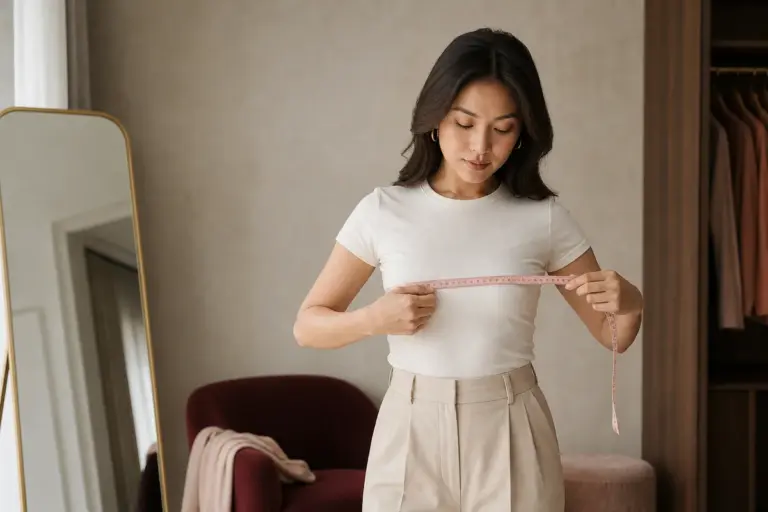
Before you use any conversion chart, it helps to have a set of recent, relaxed measurements to work from. You don’t need a fancy tailor’s tape—any soft, flexible measuring tape will work, and you can take these measurements in a comfortable, non-padded bra that you already like the fit of. If you don’t have a soft tape, you can use a length of string and measure it against a rigid ruler, too.
- Band measurement: Wrap the tape snug but not tight around your ribcage, directly under where your bra band sits. It should sit level all the way around your body, parallel to the floor. Note this number in centimeters, as it is the most common measurement used across Thai and international size guides.
- Bust measurement: Wrap the tape loosely around the fullest part of your bust, again keeping it level all the way around. Don’t pull the tape tight enough to compress your tissue—just let it rest lightly against your skin.
- Cup difference: Subtract your band measurement from your bust measurement. That difference is what most brands use to assign your cup letter, though the exact mapping varies across size systems.
Remember: these measurements don’t define your body, and there is no “good” or “bad” number. They are just reference points to help you narrow down size options when you shop. It is totally normal for your measurements to shift over time due to hormones, activity levels, life changes, or even fabric stretch in your current go-to bras.
Your Core Bra Size Conversion Chart Reference
The chart below maps common size labels across US, UK, EU, and pan-Asian sizing systems (the label set most commonly used by Thai, Japanese, Korean, and Chinese lingerie brands). Again, this is a baseline reference—always check brand-specific notes, as some lines size cups or bands differently for specific styles.
| Band (cm) | US Band Size | UK Band Size | EU Band Size | Asian (TH/JP/KR) Band Size | Cup Difference (cm) | US Cup | UK Cup | EU Cup | Asian Cup |
|---|---|---|---|---|---|---|---|---|---|
| 63-67 | 28 | 28 | 65 | 65 | 10-12 | A | A | A | A |
| 68-72 | 30 | 30 | 70 | 70 | 12-14 | B | B | B | B |
| 73-77 | 32 | 32 | 75 | 75 | 14-16 | C | C | C | C |
| 78-82 | 34 | 34 | 80 | 80 | 16-18 | D | D | D | D |
| 83-87 | 36 | 36 | 85 | 85 | 18-20 | DD/E | DD | E | E |
| 88-92 | 38 | 38 | 90 | 90 | 20-22 | DDD/F | E | F | F |
| 93-97 | 40 | 40 | 95 | 95 | 22-24 | G | F | G | G |
| 98-102 | 42 | 42 | 100 | 100 | 24-26 | H | FF | H | H |
You’ll notice one common point of confusion across systems: larger cup labels diverge quite a bit between the US and UK. For example, a US DDD is equivalent to a UK E, not a UK DDD, because the UK system uses double letters (DD, FF, GG) for incremental sizes that the US system often labels as E, F, G. EU and most Asian sizing systems tend to use single sequential letters for cups across the full size range, which makes those a bit more straightforward to cross-reference at smaller sizes.
Why Your Converted Size Might Not Fit Perfectly Every Time
It’s normal to land on a converted size and find it doesn’t fit quite right the first time you try a new brand, and that is not a mistake on your part. There are a few common reasons for these differences, all of which are easy to account for once you know to look for them:
Style differences change fit
A bra’s design will always impact how it fits, even within the same brand and size. A strapless bra, for example, is usually designed with a tighter, more supportive band to stay up without straps, so you might find you prefer a band size up from your usual converted size in that style. Padded plunge bras often have deeper, more shaped cups that may fit differently than soft, unlined bralettes made with stretch lace, which can flex to accommodate a wider range of bust shapes. Even sports bras are usually designed for different levels of compression, so a high-impact running bra may fit more snugly than a low-support lounge bra in the same labeled size.
Brand fit priorities vary widely
No regional group of brands is universally smaller or larger, but individual brands do have their own fit blocks—the base pattern they use to build all their sizes. Some brands design for a projected bust shape, while others design for a wider, softer bust shape. Some brands prefer a very snug, supportive band fit, while others design bands with more stretch for a relaxed, all-day feel. That’s why you might be a 34C in one US brand, a 34B in a UK brand, and an 80D in a Thai brand, and all of those sizes can fit you well in their respective pieces. If you see customer reviews on a product page, it can help to look for notes from other shoppers about whether the style runs tight, loose, or true to the brand’s listed size.
Fabric and construction play a role
Stretchy fabrics like lace, mesh, and jersey will give a little over the course of the day, while stiffer fabrics like satin, bonded microfiber, or structured cotton will hold their shape more firmly. Bras with multiple hook-and-eye closures also give you more flexibility to adjust the band fit as the fabric stretches over time, while pull-on bralettes have less adjustability, so you may prefer to size up or down depending on how much stretch the fabric has. You can learn more about how fabric impacts wear over time in our lingerie care guide, which includes tips to keep your favorite pieces fitting well for longer.
Quick Fit Check to Use Every Time You Try a New Bra
Once you’ve used the bra size conversion chart to narrow down your size and your order arrives, use this quick, low-pressure checklist to see if the bra works for you, no matter what size the label says:
- Band fit: The band should sit level around your ribcage, and you should be able to slide two fingers comfortably under the band at the back. It should not ride up your back when you move your arms, and it should not dig in so tightly that it leaves deep, uncomfortable marks after a few minutes of wear. When you first try a new bra, fasten it on the loosest set of hooks so you can tighten it as the fabric stretches over time.
- Cup fit: The cups should lie smoothly against your bust without gaping at the top or cutting into tissue at the sides or top. If the cups pucker or gap, you may prefer a smaller cup size; if tissue spills over the top or sides, you may prefer a larger cup size, or a style shaped for your specific bust shape.
- Strap fit: You should be able to adjust the straps so they sit comfortably on your shoulders without slipping or digging in. You do not need to over-tighten straps to get a secure, comfortable fit, as this can cause unnecessary shoulder pressure.
- Comfort test: Move around! Bend over, lift your arms, take a few deep breaths, and sit down for a minute. A well-fitting bra will stay in place and feel comfortable through regular movement, without you needing to adjust it every few minutes.
If the first size you try doesn’t fit quite right, that’s a completely normal part of shopping for lingerie, especially online. Many brands, including our own For Her Secret shop, offer easy, no-hassle exchanges for unworn pieces with tags attached, so you can find the right fit without stress.
At the end of the day, size labels are just a tool to help you find pieces that feel good on your body, not a judgment of how you “should” look. You don’t have to fit into a single size across every brand or style, and there is no prize for squeezing into a smaller label or sizing up unnecessarily. The best bra size for you is the one that feels comfortable, gives you the level of support you want, and lets you go about your day without thinking about your underwear at all.
As you explore new styles and brands, keep this conversion chart saved, and remember to check individual size guides, lean into customer fit notes, and use the quick fit check every time you try something new. If you’re browsing for your next favorite piece, you can start by exploring our full range of everyday bras, matching lingerie sets, and comfortable loungewear to find styles that match what you’re looking for.
Frequently asked questions
Can I use the same bra size for every international brand?
Your converted size is a great starting point, but every brand uses slightly different fit patterns, and style designs (like strapless or padded bras) can change fit. Always check the brand’s specific size guide before ordering.
Do all Asian lingerie brands run smaller than US or UK brands?
There is no universal sizing rule across all brands from any region. Individual brands set their own size standards based on their design priorities, so you may find some Asian brands fit looser, some tighter, and some aligned exactly with your US/UK converted size.
Why do my cup sizes vary between different bra styles?
Cup shape, padding, and fabric stretch all change how a cup fits. For example, a stretch lace bralette may flex to fit a wider range of cup sizes, while a rigid structured plunge bra has a fixed cup shape that may require a different size for a good fit.
How often should I remeasure myself for bra sizing?
It’s a good idea to take fresh measurements every 6 to 12 months, or any time you notice your regular bras start to feel less comfortable. Weight shifts, hormone changes, and even wear and tear on your existing bras can change your ideal size over time.
 Bra Sister Sizes: How They Work, When to Use Them, and Why Fit Still Varies
 Signs Your Bra Does Not Fit: Easy Fixes for Riding Bands, Gaping Cups, Spillage & Slipping Straps
 How to Measure Bra Size: A Simple Step-by-Step Home Guide